TL;DR - Frontier Airlines notified the Vermont Attorney General on or about July 9, 2026 that passenger data including Social Security numbers was exposed. The airline has not disclosed how many people were affected or how the breach happened. The next move is a check, not a panic. What you need to do:
It starts with an email you almost archived. "Frontier: We take your privacy seriously", some corporate font, the legal boilerplate that every company sends after an incident. The inbox has had five of those this year and they all read the same.
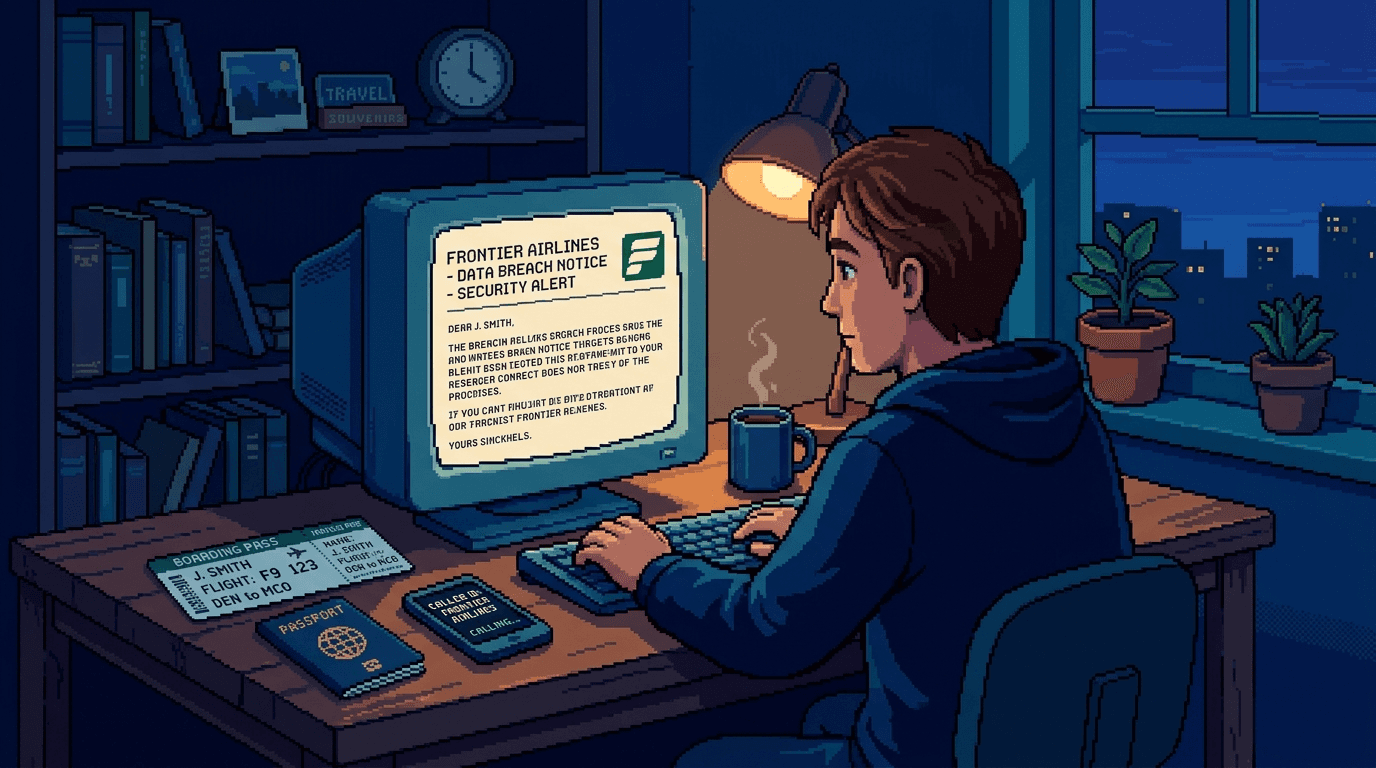
This one is different in the third paragraph, where most people stop reading. The Frontier breach notification lists the data categories the company held on you, and that list is the part that changes the math. Social Security numbers are on it. So is the rest of the passenger profile the airline built up the first time you booked a flight: your name, home address, date of birth, the payment card, and the ID you handed over at check-in.
Your Frontier booking cost $49 one-way. The data you handed over to make it is now worth more to a scammer than the ticket was to you.
If your data was caught in this kind of breach, here is what the next six months look like and how you stay ahead of it. None of the moves depend on Frontier telling you what happened, because Frontier has not.
What Frontier Actually Disclosed
Frontier Airlines disclosed the breach to the Vermont Attorney General on or about July 9, 2026, which means the airline told a state regulator about an incident affecting its customers. Vermont's data breach notification law (9 V.S.A. section 2430) requires companies to file that report when resident data is involved, so the existence of the breach is confirmed by a regulatory filing, not just by Frontier saying so.
What Frontier has not disclosed is the part most readers want first: how many people are affected, how the breach happened, and which records were touched. The notification states that the airline "did not provide specific details about the nature or scope of the breach," which is unusual in tone but not in practice.
What Frontier has confirmed is that the exposed data may include Social Security numbers and other sensitive personally identifiable information. That sentence moves this breach out of the "we were hacked, change your password" category and into the identity-theft category. A Social Security number is not a password. You cannot rotate it.
Two honest framing rules. If you received a notification from Frontier, treat it as confirmation your data is in the affected group. If you have not received one but you have booked with Frontier in recent years, do not assume you are safe. Frontier has not published the scope, so anyone whose profile is on file should run the same playbook.
If you are an Australian reader and have never flown Frontier, the breach still matters. The same data shape, the same regulatory notice, and the same follow-up scam pattern will land at another carrier soon enough. Treat this as the playbook you would run when your own airline of choice sends a similar notice.
Why Airline Data Hits Different
An airline breach is not the same shape as a breach at a retailer or a healthcare provider. The reason is the profile an airline builds and keeps.
When you book a flight, you hand over a passenger name, a date of birth, a home address, an email, a phone number, a payment card, and, depending on the route, a passport number or a known-traveller number. The airline stitches that into a passenger profile that gets you through check-in and sends boarding passes for the next decade. The breach did not grab your booking confirmation. It grabbed a copy of the profile that sits behind every booking you have made.
Three things make that profile particularly useful to a scammer. First, it contains identifiers that survive password resets: a Social Security number does not change when you change your Frontier password, a date of birth does not change when you freeze your credit card, a passport number does not expire when your loyalty card does. Second, it gives the scammer enough accurate detail to make the next contact sound like administration. A caller who knows the route you flew last Tuesday and the name on your booking is harder to verify than one who only knows your email. Third, it cross-references with what the scammer already holds. Most people have pieces of their identity floating through at least one old breach, and the Frontier data slots in to make the profile more complete.
The follow-up does not look like "click here to reset your password." It looks like "your flight to Denver has been cancelled, click here to rebook," or "we have an issue with your known-traveller number, please confirm your details," or "your Frontier loyalty balance has expired, log in to claim it." Each pitch uses a piece of the breached data to feel routine, and the goal is to extract one more piece the breach did not contain: a one-time code, a payment card, a fresh identity document.
If your only Frontier booking is years old, the data is still the kind a scammer can build a story around. Dates of birth do not change. Passport numbers do not expire. The age of the booking does not weaken the breach much.
The same shape of profile sits at every airline you have flown, and the same shape of breach lands at each one every few years. The post on why scammers already know your information walks through how those separate scraps are stitched into a single profile a scammer can act on. An airline breach just adds another set.
Your Airline-Breach Playbook
The playbook is three short moves. None of them depend on Frontier explaining what happened.
First, gather what data Frontier has on you. Log into your Frontier account if you still have one, and check the profile page for the data categories on the breach notification. You are looking at what was on file when the breach happened, not what is there now. If the profile lists a passport number, an old home address, or a payment card you have since replaced, write down what is there.
Second, confirm whether you received a notification. The breach notice on the airline's site, if there is one, is the start. If you have not received a notice but you have a Frontier account or have booked with the airline in recent years, do not wait for one. The airline is under no obligation to email everyone whose data was on file, and "no notice received" is not the same as "data not affected." Treat the absence of a notice as uninformative and act as if your data may be in the affected group.
Third, watch for breach-themed contact in the next ninety days. The scam shape is predictable: a text or email that uses a real detail from your booking to make a request feel routine. Refuse every unexpected request, even one that knows your itinerary, and initiate contact with the airline yourself if you need to act on something real. No genuine airline asks for a one-time code or a payment card by inbound call. Hang up if a caller does.
For context on the broader pattern, the 24-hour data breach response guide walks through the same shape of moves for any breach notification, and the Canvas breach playbook shows how the same routine applies when the breach is at an education provider rather than an airline. The airline context is the new wrapper. The check underneath is the same.
What You Need To Do
These are short jobs, not a weekend project. Run them in order.
-
Check your inbox for a Frontier notice. Take 2 minutes. Search for "Frontier" and look for anything with "we take your privacy" or "notice of data" in the subject line. If you find one, screenshot it and keep the message in a dedicated folder. The date of the notice is the cleanest proof that you were in the affected group if you later need to file an identity-theft report. Do not click any links inside it.
-
Pull up your Frontier profile. Take 5 minutes. Log in from a fresh tab, not from a link in an email. Look at the profile page: name, date of birth, home address, phone, payment cards on file, known-traveller numbers, passport details if any. Write down what is there. This is the list of identifiers a scammer might be holding.
-
Freeze your credit at the US bureaus, or place a credit ban in Australia. Take 10 minutes. If you are a US reader, freeze your file at Equifax, Experian, and TransUnion. A freeze is free, takes about ten minutes per bureau, and prevents a new account from being opened in your name without a separate thaw step. If you are an Australian reader, the closest equivalent is a credit ban, which Equifax Australia, illion, and Experian Australia all offer. A credit ban tells the bureau not to share your credit file with a lender without your explicit approval.
-
Watch the accounts tied to your travel profile. Take 10 minutes. Open the bank account tied to the payment card on file with Frontier, review recent transactions, and turn on transaction alerts if you have not already. Repeat for the email account tied to your booking. If the breach exposed an email-password combination, a password reset on that email is the most useful follow-on attack.
-
Update your Frontier password. Take 5 minutes. Change it from a device you trust, using a password manager to generate something you do not have to remember. If the breach exposed security questions, change those too, and prefer an authenticator app over SMS for any two-factor option. The Frontier login itself is not the highest-value target, but it can be a foothold into your email if the two passwords were ever the same.
-
Set a three-month calendar reminder. Take 1 minute. Book a reminder for ninety days from today to repeat the checks above and review your credit file again. Breach fallout peaks long after the news cycle moves on, and second-wave scams start when the first wave of "remain vigilant" notices has been forgotten. The reminder forces the check at the time it matters most.
-
If you are in Australia, treat your Medicare number like an SSN. Take 5 minutes. Sign in to myGov, open Medicare, and review recent claims. Anything you do not recognise is the first signal of Medicare misuse, the Australian equivalent of Social Security misuse. If you see activity that is not yours, contact Services Australia on the official number and ask them to lock the account while you investigate. Medicare numbers are not as catastrophic as SSNs in practice, but they are still useful to scammers.
The reminder catches the second-wave scam. A breach notice arrives, the inbox calms down for a few weeks, then a "Frontier loyalty" message lands that looks like spam but contains a real detail from your booking.
For Australian readers, the ACSC report-and-recover guidance is the equivalent of the US CISA identity-theft recovery guide, and the OAIC notifiable data breaches page is the Australian equivalent of the Vermont AG notification requirement. For ongoing Australian credit monitoring after the ban, Equifax Australia, Credit Simple, and illion are the three most commonly used.
Further Reading
- Vermont Attorney General - Security Breach Notices (the regulator Frontier notified)
- Frontier Airlines Data Breach notice (Edelson Lechtzin LLP, via PRNewswire) (the original press release; treat as confirmation of the breach, not as independent reporting)
- CISA - Identity Theft and Social Media guidance (US government recovery resources)
- FTC - IdentityTheft.gov (US readers: official recovery plan)
- ACSC - Recovering from Identity Theft (Australian readers: official recovery plan)
- OAIC - Notifiable Data Breaches scheme (Australian regulatory framework)
- Why Scammers Already Know Your Information (SecureInSeconds explainer on the data-assembly pattern)
- What to Do in the First 24 Hours After an Email Data Breach (SecureInSeconds immediate-action guide)
Mathew Clark / Founder, SecureInSeconds / Currently: explaining to my kids that yes, Frontier does count as an airline even though nobody brought us a snack